Death by CVE: Why We Need Execution-Centric Security
As adversaries pivot from ransomware to physical sabotage, antiquated scan-and-patch models are beginning to fail. In complex systems, the mere presence of a vulnerability is a poor proxy for risk; danger lies only in what is reachable. We must shift to execution-centric security: validating active attack paths rather than static ingredient lists. By prioritizing reachability, we stop chasing false alarms and focus on the structural flaws that actually threaten critical infrastructure.
Jack Schultz
Author
Product security principles over cyber / physical systems have previously been governed by an equilibrium: attacks were after data and manufacturers sought uptime. The main threat to a connected device was data exfiltration (excluding one-off instances like Stuxnet and the 2015 Ukraine Power Grid hack - which have proven these attacks are feasible). Attacker ROI was calculated in stolen credentials or the volume of PII they could extract. Malicious actors have, of course, moved to ransomware. Yes, this impacts uptime, but the driving incentive behind the attack is financial. Companies will pay a heavy fee for decryption keys to get their business back online.
To understand why the world hasn’t burned down from a cyber incident (yet), one must look at these motivations. Historically, cyberattacks offered low risk and high reward incentives. The vast majority of threat actors operating today are capitalists, not anarchists. They view the modern cybercrime ecosystem as a business instead of a battlefield. While disrupting operations is lucrative, destroying the infrastructure required to pay the ransom is simply bad for business. This economic rationality has created a ceiling on violence; most profit-driven actors operate under an unwritten rule: keep the body count at zero, and don’t become a priority for the NSA.
Another group of actors, hacktivists and ideologues, have also historically operated within the lines of what can be best referred to as “accepted behavior”. Their objective is attention and transparency, not casualties. While these actors are willing to risk legal repercussions to bring sensitive information to light, the calculus changes entirely when human life is at stake. There is a massive psychological and legal leap between defacing a website and taking a hospital ventilator network offline.
This deterrence model extends to nation-states. Adversaries like Russia, China, Iran, and North Korea undoubtedly possess the access and weaponry to inflict physical damage on U.S. infrastructure. So why haven't they pulled the trigger? The constraint is not technical, but geopolitical. A cyberattack that causes significant loss of life or catastrophic economic disruption crosses the threshold from espionage to an act of war.
However, the geopolitical climate is deteriorating. Alliances are fracturing, and the calculus of deterrence is shifting. It is dangerous to assume that the current model of mutual restraint will hold indefinitely. If a desperate nation-state determines that the consequences of inaction outweigh the risks of a strike, the scales shift, and we will quickly discover that we are woefully unprepared.
The proof of concept for real world impacts already exists. We have watched ransomware groups paralyze fuel pipelines and halt food processing chains. Yet, we have not witnessed an attack designed specifically to induce mass casualties or total economic collapse. This absence is not a testament to our defenses, but a lesson in incentives. The grid is still humming and the water supply remains potable solely due to a precarious balance of criminal economics and geopolitical Mutually Assured Destruction.
As the attack surface expands, the potential for catastrophe scales with it. We are laying the foundation for a hyper-connected mesh of infrastructure, deeply reliant on Edge AI and opaque decision-making protocols. We are wiring bridges, dams, and power plants to the open internet, yet we continue to secure this futuristic architecture with a mindset anchored in 2010. Security teams are drowning in noise, tasked with remediating thousands of component vulnerabilities in isolation. Without understanding how these components interact within the system, the industry has resigned itself to a 'patch-and-pray' methodology.
Adversary attacks are evolving. Intelligence indicates that nation-state actors and advanced criminal groups are no longer satisfied with simple data extraction; they intend to compromise the system's integrity. By poisoning upstream repositories or embedding dormant logic bombs within firmware, adversaries are effectively actively weaponizing the software supply chain. Attacks are moving from surveillance to sabotage. In this context, traditional corporate deterrents, lawsuits, recalls, or reputation damage, are rendered irrelevant. These mechanisms offer no leverage against an adversary whose goal is not profit, but kinetic impact.
To secure Industry 4.0, we must fundamentally reassess our defense strategy. The methodologies currently protecting our critical infrastructure are dangerously antiquated. The standard compliance workflow, generating a Software Bill of Materials (SBOM), cross-referencing it against the NVD, and producing a paralyzing backlog of Common Vulnerabilities and Exposures (CVEs), is really only utilized because a better, novel alternative does not currently exist. Plus, this is what the regulators like to see. This scan-and-patch model must be revamped for the emerging complexity of modern embedded systems.
Modern firmware images, for example, are dense, interlocking ecosystems of third-party libraries and open-source dependencies. A standard static analysis will inevitably flag hundreds of 'Critical' vulnerabilities within this stack. Fortunately or unfortunately, in the constrained reality of a purpose-built device, the mere presence of a vulnerable component is a poor proxy for risk. Presence does not equal exploitability. True risk in product security is not a list of ingredients; it is a function of execution context and system architecture.
Consider a library containing a critical Remote Code Execution flaw. If the device architecture never invokes that specific function, or if the compiler strips the symbol during the build, the risk is not nearly as high as a scanner might advertise. In contrast, a logic error in a custom driver, which no public CVE scanner will ever detect, could silently grant root access. By prioritizing remediation based on generic scores rather than architectural reachability, organizations are misallocating critical engineering resources: burning cycles on phantom vulnerabilities while leaving the true structural flaws wide open.
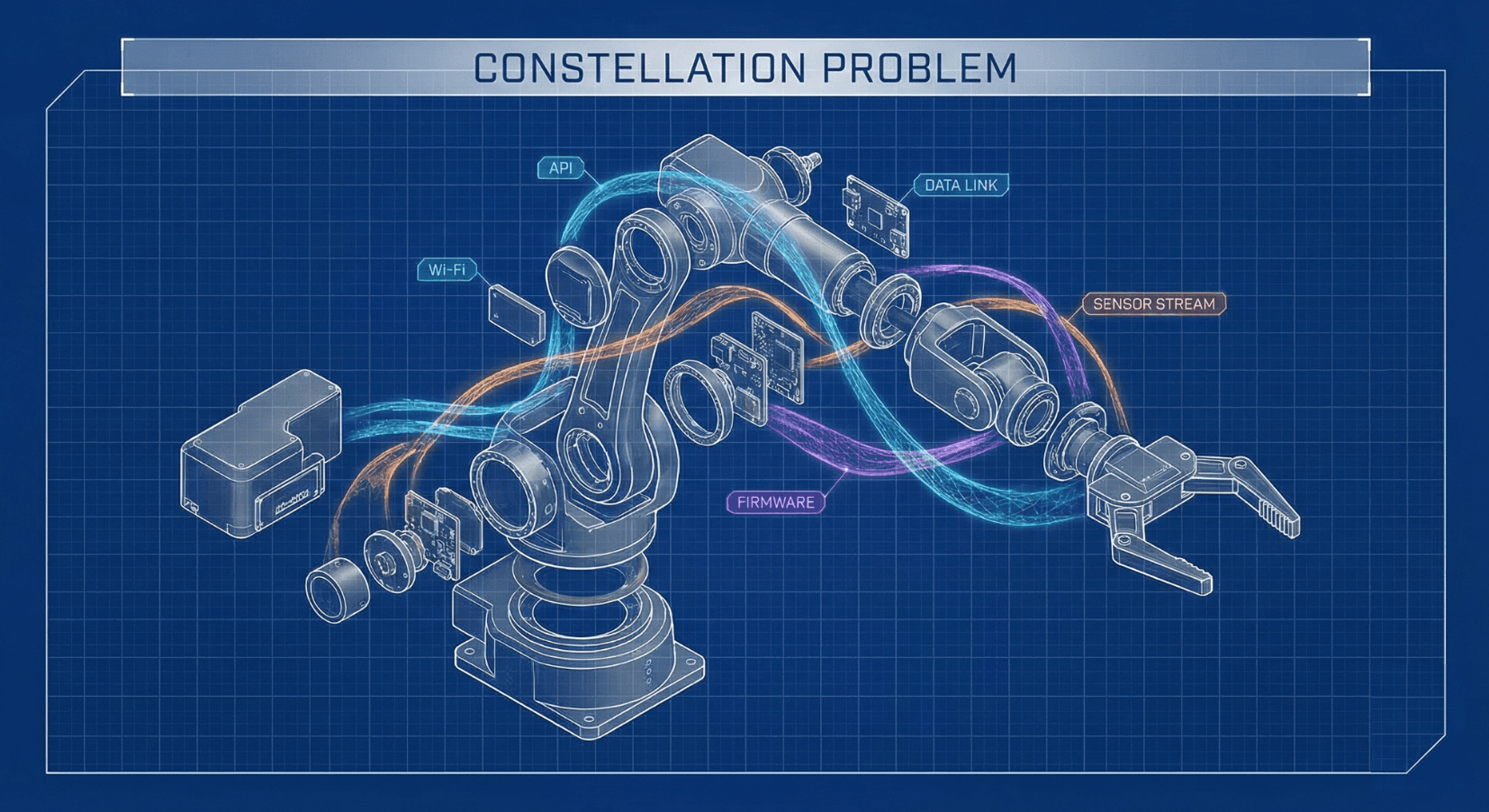
The complexity of modern product architecture has effectively deprecated manual threat modeling. The era of the monolithic codebase is over; today’s device is a heterogeneous system-of-systems, fusing Real-Time Operating Systems (RTOS), containerized applications, proprietary logic, and third-party SDKs. In this fractured environment, vulnerability is rarely a simple coding error within a single component. It is an emergent property of the architecture itself, a failure that exists only in the seams between systems.
Adversaries armed with automated fuzzing and AI-driven analysis are not hunting for unpatched libraries; they are interrogating the logic gaps between them. They target the seams of the architecture, exploiting how the Bluetooth stack handles memory allocation during a handover to the application layer or triggering race conditions that manifest only when a cloud API and local firmware contend for flash memory simultaneously.
The inventory approach collapses in this environment. An SBOM provides a static list of ingredients, but it remains blind to the volatile interactions that occur at runtime. A flat list cannot predict dynamic failure modes. To secure the next generation of connected infrastructure, we must support both Component-Centric Security and Execution-Centric Security, where we can understand the attack paths that perpetuate negative outcomes.
We must advance beyond static composition analysis toward a dynamic 'War Gaming' of the device. We need a future that allows us to understand what can go wrong, or what has to go right, then show us the scenarios of how this can happen. The objective is to validate reachability: determining not merely which libraries are present, but which code paths are actually traversable by untrusted input.
This is the specific engineering gap addressed by ArgusEye.
Rather than treating an analysis as a conclusion, our product leverages system architecture to validate actual exploitability. By reconstructing the execution logic of the system and the relationships between components modeled in insolation, we can rigorously differentiate between a vulnerability that is effectively dead code and one that lies exposed on a critical execution path.
Consider the operational reality: a 'Critical' CVE in an XML parsing library is just noise if the device communicates exclusively via JSON. Conversely, a subtle memory leak within a proprietary protocol which would typically be invisible to standard scanners, escalates into a catastrophic failure mode if architectural analysis reveals it can be triggered remotely. In a safety-critical loop, that leak is not a bug but instead a remote kill switch.
The resilience of our critical infrastructure hinges on the integrity of the connected edge. That integrity cannot be secured by chasing CVEs in a spreadsheet. It demands a definitive shift in validation logic, moving from auditing ingredients to testing interactions. The adversary is already reverse-engineering our binaries for structural weaknesses; it is time we did the same.