The Death of Determinism: Why Edge AI Breaks Traditional Product Security
As Edge AI replaces deterministic code with probabilistic models, the line between Security and Safety dissolves. Standard metrics like CVSS fail here by ignoring physical context. This article explores the "Constellation Problem" and offers three imperatives for resilient autonomy: Audit the Probabilistic, Map the Physics, and Embed controls. We must stop obsessing over secrets and start protecting physics.
Jack Schultz
Author
For forty years, Operational Technology (OT) security relied on a single, comforting assumption: Determinism.
In the traditional industrial world, a machine was a closed loop. Input A always resulted in Output B. If a robotic arm swung left instead of right, it was either broken or it had been hacked. Security was binary, and the threat model was focused on maintaining that deterministic state (Integrity and Availability).
But as we embed Artificial Intelligence into the devices that live on the edge of compute—from autonomous fleets to medical robotics—we are breaking that pact.
We are replacing deterministic code with probabilistic models. An AI agent doesn't execute a command; it makes a decision. It calculates the statistical likelihood that a pixel is a pedestrian, or that a vibration is a bearing failure.
This shift erases the line between Security (protecting the device from the world) and Safety (protecting the world from the device). In this new paradigm, the "CIA Triad" isn't lopsided; it is obsolete. We are no longer just securing data; we are securing physics.
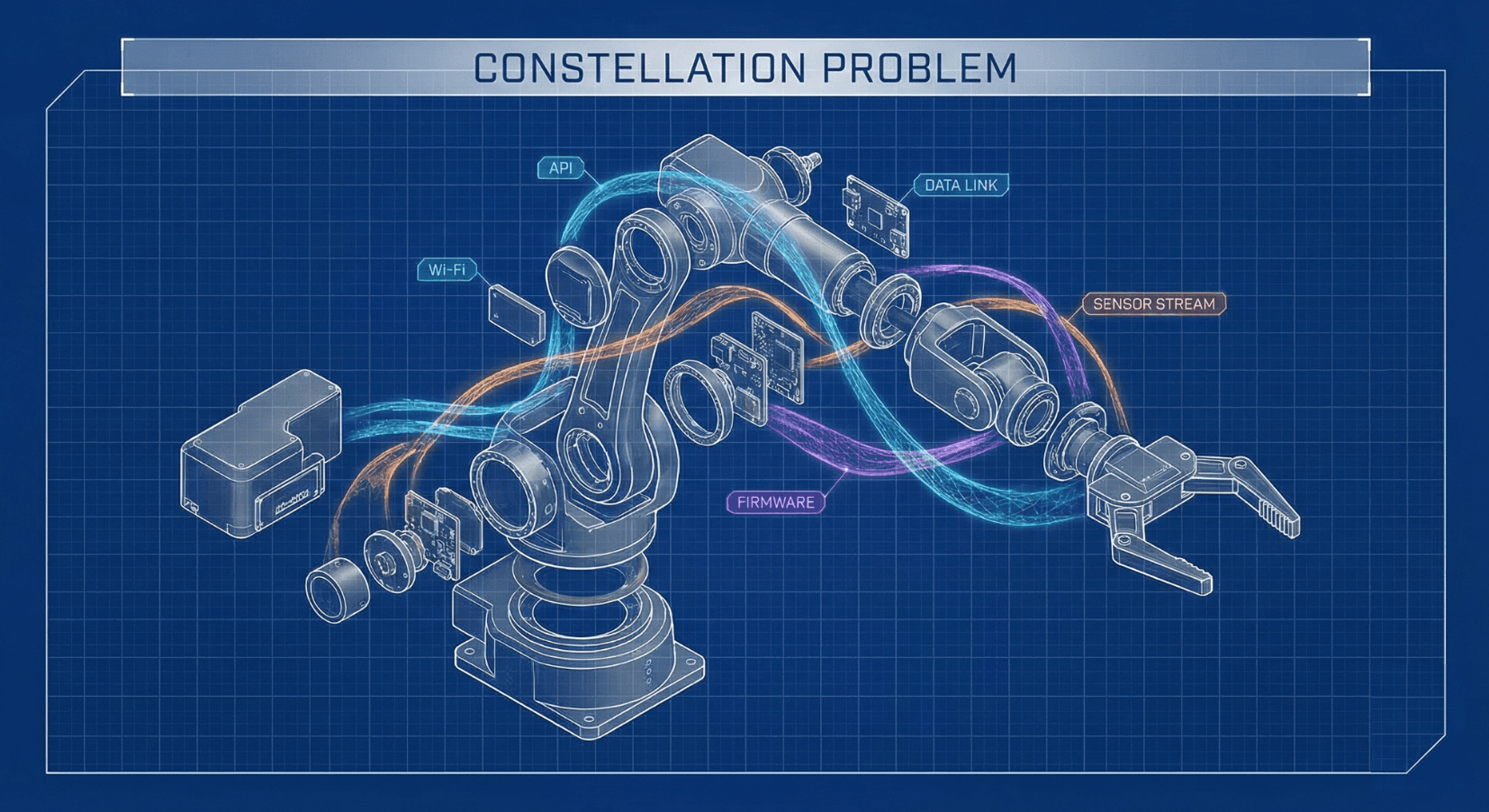
The Constellation Problem
Why has the industry struggled to adapt? Because we are trying to apply web security thinking to hardware ecosystems.
In the cloud era, a web application was a monolith—a centralized block of code that could be patched instantly. If you found a vulnerability, you deployed a fix.
An Edge AI device is not a monolith; it is a constellation. It is a compressed supply chain containing:
Mobile Interfaces (interacting with apps)
Web Interfaces (reporting to the cloud)
Embedded Logic (firmware and RTOS)
AI/ML Models (NPUs and inference engines)
We have rigorous standards for the components in isolation—MASVS for mobile, ASVS for web, EMB3D for firmware, and ATLAS for ML. But a device is the interaction of these parts. A generic compliance checklist cannot capture the risk that emerges when a probabilistic AI model interacts with a deterministic actuator.
The Failure of CVSS in a Physical World
The industry’s standard metric for risk, the Common Vulnerability Scoring System (CVSS), is mathematically blind to physics.
In a pure IT environment, a Remote Code Execution (RCE) vulnerability is always critical. But at the Edge, context is everything.
Scenario A: An RCE vulnerability exists in a Wi-Fi module on a smart thermostat.
Risk: Low. (Annoying, but not dangerous).
Scenario B: The same RCE vulnerability exists in the same Wi-Fi module on an insulin pump or an industrial centrifuge.
Risk: Critical. (Life-threatening).
Current threat modeling creates Alert Fatigue because it lacks this physical context. It screams "Fire!" for every bug, regardless of whether that bug can actually impact the kinetic world.
The Solution: Automating Contextual Intelligence
We cannot solve this by throwing more humans at the problem. The complexity of the Bill of Materials (BOM) and the volume of components make manual threat modeling impossible at scale.
This is where AI acts not as a magic wand, but as a Context Engine.
We need to move beyond static code scanning and toward Contextual Mapping. This involves using AI to ingest design documents, schematics, and source code to map technical controls to physical risks.
Ingest: The system identifies a Bluetooth component.
Contextualize: The system reads the schematic and recognizes the component is physically air-gapped during operation, or only active during maintenance mode.
Evaluate: The AI maps this against NIST 800-53 or ISA/IEC 62443.
Score: The risk score is automatically downgraded based on physical reality, not just software severity.
This allows product security teams to stop reviewing false positives and start focusing on the 1% of threats that can actually cause kinetic damage.
Three Strategic Imperatives for the Edge
The goal is no longer just secure code. The goal is resilient autonomy. To get there, Product Security leaders must adopt three new imperatives:
1. Audit the Probabilistic
We know how to scan code for syntax errors. We do not yet have a standard for auditing Decision Drift. Security teams must expand their scope to include the integrity of the inference engine. Is the model hallucinating? Has the training data been poisoned? In an AI device, bad data is just as dangerous as a bad packet.
2. Map the Physics
Stop treating all devices as equal endpoints. A vulnerability's severity must be weighted by its physical consequence. If a compromise cannot result in kinetic manipulation or supply chain halted, it is a secondary priority. We must prioritize Safety (Physical) over Confidentiality (Data).
3. Embed, Don't Wrap
"Shift Left" has become a cliché, but for hardware, it is a law of physics. You cannot patch a device at the bottom of the ocean. Security controls must be ingrained into the hardware architecture—using hardware roots of trust and secure enclaves—before the device leaves the factory.
The Bottom Line
The ROI of the AI revolution is predicated on autonomy—machines that can work without us. But autonomy without integrity is just liability.
If we continue to use web-era security models for physical-era machines, we won't just have data breaches. We will have accidents. It is time to stop obsessing over secrets and start protecting physics.